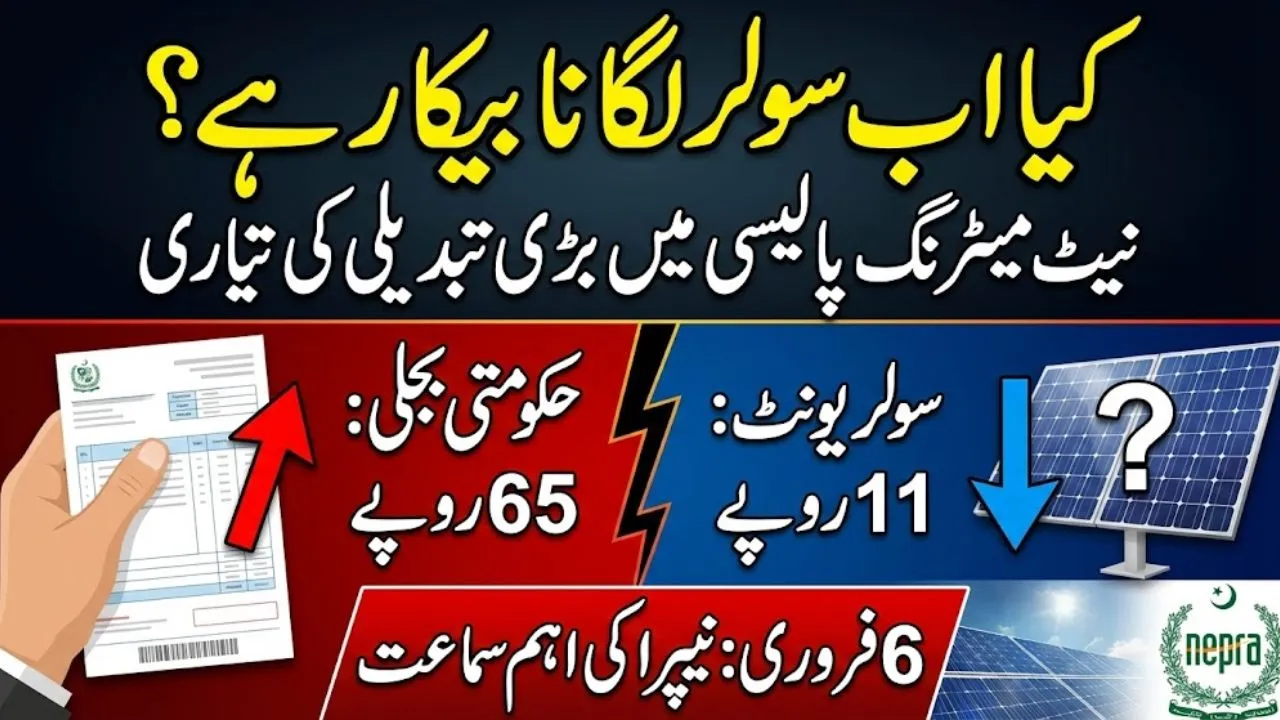
The federal government has moved closer to ending the unit-to-unit electricity adjustment facility for solar consumers as part of proposed amendments to the country’s net metering policy. The National Electric Power Regulatory Authority (NEPRA) has scheduled a public hearing on February 6 to review objections raised by consumers and industry stakeholders before making a final decision.
According to officials, NEPRA issued a draft of the proposed amendments on December 16, inviting feedback and objections within a 30-day period. The regulatory authority confirmed that all submitted concerns will be examined during the upcoming public hearing, after which a final notification may be issued.
Proposed Shift from Net Metering to Net Billing
Under the proposed changes, the existing unit-to-unit adjustment mechanism for rooftop solar users would be discontinued. Instead, a net billing system would be introduced, fundamentally altering how solar consumers are charged and compensated.
Officials said the price of exported electricity units is expected to be fixed at Rs. 11 per unit. If approved, consumers will receive:
- One bill for electricity consumed from the national grid at the applicable tariff
- A separate credit calculation for electricity exported to the grid
This would replace the current net metering system, where imported and exported units are directly offset against each other.
 WhatsApp Channel
Government’s Rationale Behind the Amendments
The proposed amendments are part of the government’s broader strategy to reduce energy sector costs and create a more sustainable and effective tariff framework. Officials believe the revised policy will help manage growing pressure on the national power system amid rising rooftop solar adoption.
Authorities argue that the current net metering structure places an additional financial burden on the grid, particularly as solar capacity continues to expand across residential and commercial sectors.
Concerns Raised by Solar Consumers and Industry
The draft amendments have triggered serious concerns among solar users and industry stakeholders, who warn that ending unit-to-unit adjustment could negatively impact the financial viability of rooftop solar installations.
Stakeholders have argued that:
- Lower export rates may extend payback periods for solar investments
- The proposed Rs. 11 per unit rate does not reflect rising electricity costs
- Policy uncertainty could discourage future renewable energy adoption
These objections are expected to be a central focus of NEPRA’s public hearing.
What Happens Next
NEPRA has stated that all objections submitted by stakeholders will be reviewed during the February 6 hearing. A final decision on the amended net metering policy will only be taken after this consultation process is completed.
Until an official notification is issued, the existing net metering policy will remain in effect.

Impact on Solar Market
If approved, the changes could mark one of the most significant shifts in Pakistan’s rooftop solar policy, potentially reshaping consumer behavior, investment decisions, and future renewable energy growth.
Solar consumers and industry participants are advised to closely monitor developments following the public hearing, as the outcome may have long-term implications for energy costs and renewable adoption in the country.